Automation in fleet management is a coveted tool that saves time and simplifies operations. You may even be tempted to think, “The more automation, the better!” But before you get dazzled by the buzzword, “Agentic AI”, recognise that AI technology is far from autonomous, and the label is often oversold as something it isn’t.
Does automation exist in advanced fleet management software? YES
Has it reached the point of relative autonomy? NO
Let’s separate the reality from the hype and show you just how capable agentic AI is in fleet management as it stands so far.
Agentic AI in fleet management speaks to a spectrum of operational automation that eventually cancels out the need for many of the tasks fleet managers perform. In other words, if your agentic AI was at 100%, your fleet would run itself without the need of a fleet manager.
Does this technology exist at the 100% level? Not even close. Agentic AI exists as a means for automation on an impressive scale, but fleet managers are still very much needed to run these systems.
But that’s probably not what you’ve read elsewhere. Many fleet software providers are claiming agentic AI without explaining the concept of autonomy (and where that autonomy really lies).
Your fleet manager can’t just press a button and watch AI run your fleet. They still need to actively participate in the operational processes of your fleet’s decision making.
Fleet management software companies are happy to label their products as having agentic AI, when in fact these systems are often run on rule-based systems. Are these systems advanced? Absolutely. But are they autonomous (or agentic)? Not completely.
Unfortunately “agentic AI” has become a buzzword used to sell software. In reality, the level of automation FMS offers is relative.
The term “Agentic AI” carries a preconceived idea that fleet automation has reached an amazing level that includes:
The problem with these impressions is that newer companies think the software is enough to run their fleets without the need for a fleet manager. They budget for the software without accommodating for the staff needed to operate it.
Terms that accurately describe the capabilities of fleet management software today will sound more like this:
Fleet software is impressive. And yes, AI is what makes it impressive. But when you’re buying this type of software for your company, it’s helpful to know what that AI can actually do and what its limitations are.
An AI agent forms one part of a software system umbrella that you deploy for the purpose of automatically managing a particular process within your fleet. If “agentic” is the umbrella, then an “agent” is one of several parts of that umbrella. Each agent gets a specific assignment with regards to decision making based on particular conditions set out in the software, or as depicted by the fleet operator using the software.
When AI agents are used in fleet software, the expectation is that they’ll have the ability to take action based on individual decisions they make. However, this is often an overpromised feature that’s fairly limited so far, which is where a fleet manager is needed to operate, monitor and control the agents.
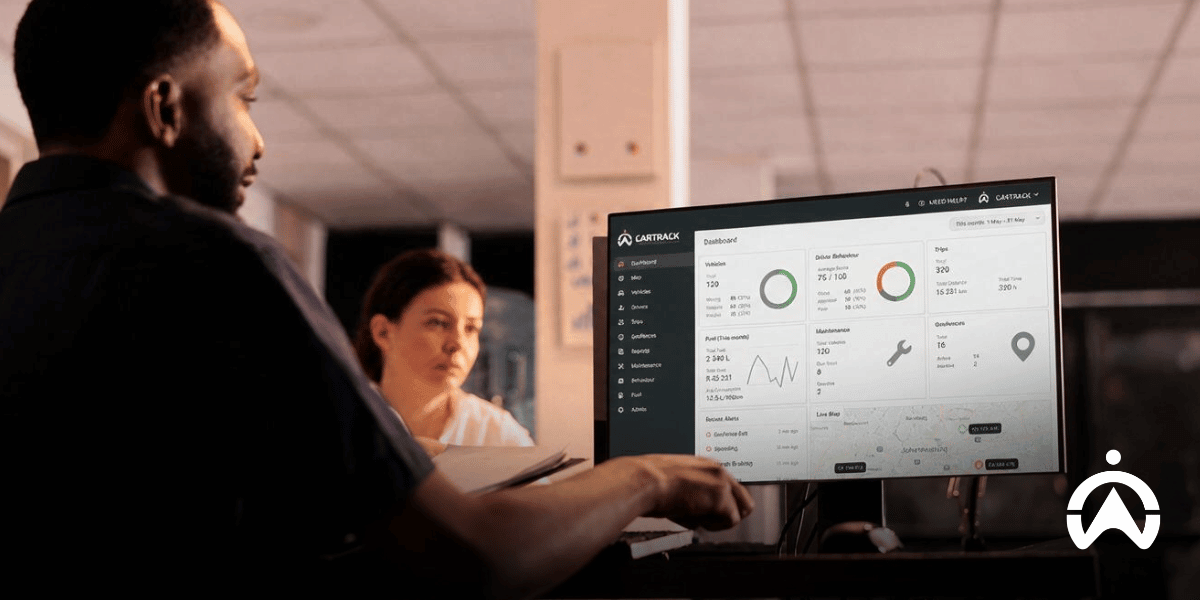
We can safely round off the various levels of autonomy in agentic AI to 4 levels. Level one is purely notification-based. Level 2 is suggestive, requiring a decision maker (like the fleet manager) to act on the suggestion. Level 3 is where the system makes decisions based on presets stipulated by the fleet manager. Level 4 is full autonomy.
While fleet software companies might rebrand their AI software as fully autonomous, in reality the best fleet technology has only reached level 3 (the ability to take action within the fleet operator’s guard rails). This is good news for new & existing fleets who want to adopt more AI automation into their fleets; but only if they buy wisely.
Here’s what agentic AI is capable of in fleet software so far.
The fleet dispatcher is still needed to navigate the ins and outs of vehicle & driver scheduling, but the task is made so much easier with AI-powered route optimisation. This software uses AI to accurately predict the best routes and schedule the best driver (based on their real-time location) for each task.
Instead of relying on service schedules, predictive vehicle maintenance connects to the CAN bus system of your vehicle and feeds diagnostic data to your platform. If a component like the engine, tyres, transmission, or battery approach near-critical conditions, the data will alert you and automatically book the vehicle in for a service. It’ll also schedule the most efficient fill-in vehicle to prevent operational disruption.
Measuring fuel is one thing, but agentic AI actually works out corrective actions that help the fleet manager make decisions that help stop waste. This could be in the form of idling prevention, leak detection, fraud alerts, or fuel slip anomalies based on what’s in the fuel tank.
One of the most used versions of AI in fleet management is voice alerts in dashcams. These cameras have built-in AI detection capabilities that can “see” signs of distraction, fatigue or not buckling up. Once these dangerous behaviours are detected, the camera “speaks” out a relevant warning like, “No seatbelt detected”.
Despite what other fleet software providers are promising you, AI is still far from reaching a fully autonomous state. Fleet managers still play an integral role in making the best decisions for a fleet, and AI is just a tool they should be using to do a better job at it.
So what CAN’T agentic AI do? And why are fleet managers still so important for coming alongside this technology?
To keep company stakeholders satisfied, a human fleet manager with answers and justification for decisions is strongly needed. Investors don’t want to speak to an AI bot about high stakes decision making. They want clear human answers to human questions.
Stakeholders also want someone to be responsible for the success or failure of their fleet. If numbers are down, an agentic AI system won’t be able to justify either. It’s only capable of reporting what it’s done, not why it did it.
Times keep changing, and no agentic AI exists that’s so adaptable that it can grow with the times. If fuel prices go up, or ESG becomes more strictly mandated, you need a fleet manager to adapt the software accordingly.
Drivers will relate better to another human being coaching them with the help of technology rather than to the technology itself. Relating the importance of safety and the company reputation is something agentic AI simply can’t do.
Every fleet is unique, and so is its workflow. To properly adapt agentic AI to YOUR fleet takes an intuitive person who knows how it works and how it can benefit the particular processes of your operations.
Customers don’t always want to deal with people, but when something goes wrong, they certainly don’t want to speak to an AI agent. Agentic AI is great at running processes automatically until things come to a halt. When that happens, customers need someone they can relate to.

Looking at the duties above, we notice that fleet managers are highly necessary, and that agentic AI is there to support their tasks rather than replace them. Agentic AI makes these processes much simpler through accurate reporting, making suggestions on improvement, and gathering material for intentional driver coaching.
As Samantha Andrews, Cartrack's head of operations for ADAS says, "AI in fleet software should enhance the duties of a fleet manager—not replace them. It should act as a decision-support layer, not an unchecked autonomous operator."
Removing human error from the operational equation in fleet management gives you accurate reporting and justification for the decisions you or your fleet managers make. These reports may be general and easy to understand, but in the background they’re formed by intricate data and tiny details that most managers would miss.
The fleet manager is integral to the strategy of any fleet. While agentic AI may help with algorithms, statistics and telematics data, it’s the fleet operator who ultimately has to form the best strategy and put in place for a uniquely efficient operation.
Samantha also supports this. "The real opportunity for AI in fleet software isn’t to create a 100% autonomous fleet that operates without humans, but rather to make the fleet manager much more effective. The challenge is avoiding AI for AI’s sake.”
She goes on to say, “The most valuable applications from companies like Cartrack are those that help fleet managers move from reacting to problems to proactively managing the fleet. The measure of success shouldn’t be how autonomous the software is, it should be whether it helps a fleet manager operate a safer and more efficient fleet."
Whether it’s the initial training of a new driver or the ongoing coaching of existing ones, the fleet manager’s efforts are made multiple times easier with actual training material. Not generic material, but footage and stats from your own fleet.
Vehicle cameras and CAN bus reading hardware work together to give you real-world material that’s not only useful for general training, but one-on-one focused coaching for repeat offenders in your driver team.
More governments across the globe are working to introduce regulations for commercial fleets that comply with the world’s Environment, Social and Governance (ESG) objectives. Agentic AI and telematics are massively helpful in your efforts to transform a fleet to EVs, and then run that electrified fleet optimally.
To what extent is my fleet manager responsible for operational tasks when using your agentic AI software?
This is an important investment question. Don’t spend your entire fleet management budget on software and expect it to do everything for you. Factor in the need for a fleet manager and allow a Cartrack agent to train your fleet manager on how to use the system.
Will your software gradually get more adept at solving problems specific to my fleet?
This is a fair question, but remember that currently there’s no dedicated software with agentic AI that can “learn” about your fleet’s intricacies. What we can do is scale your software as your fleet grows, consistently addressing emerging issues with a wider set of AI options.
Will you continually develop your agentic AI in the future or will I need to purchase an updated version a few years from now?
Some fleet software providers will simply sell you a software package as a once-off with support. But at Cartrack, we continually update and improve our software offerings using AI and superior hardware designs.
Emerging fleets make up a large portion of sales targets for fleet software companies pushing the AI agent label. These operators don’t realise that they’ll need to hire someone to manage their fleet (and the software itself), or do so themselves. Agentic AI therefore carries the risk of becoming an impulse buy.
The same can be said about any fleet that’s considering the adoption of fleet software into their company. These operators are vulnerable to having products sold to them that can’t entirely do what they expect.
If you’re thinking of adopting AI fleet management software into your company, partner with the company that’s been pioneering these concepts from the beginning.
Cartrack has been implementing AI into our fleet software for years now, but we never confuse agentic AI with autonomous AI. Our software is a tool that makes the fleet manager’s life easier by freeing up time and removing human error from mundane tasks.
Our fleet management software also uses complex algorithms to always provide the most accurate information possible. This same information is made available to the fleet manager to enhance their workflow and optimise their operational capabilities.
We’re confident in the progression of our technology, which is why we offer a free demo to any fleet operator wanting to pilot a fleet process using AI precision.

How advanced should AI tools in fleet management become before they’re considered “agentic”. Automation levels explained and the hype debunked.