
The amount of diesel a truck should use per km is entirely based on factors like engine size, driving & road conditions, truck size, and cargo load. The average consumption numbers will tell you about 0.3 to 0.4 litres per kilometre (or 30 to 40L/100km ), but keep in mind that these figures reflect ideal conditions.
Getting more accurate numbers requires you to carefully monitor actual consumption against your fleet baselines. This way, you can easily and properly identify where fuel is being wasted. And what better way to comprehensively monitor your fleet’s diesel consumption than with the help of Cartrack’s fleet management system!
The average fuel consumption of different types of trucks is as follows:
These numbers are based on general manufacturer specifications and the typical weight of each truck category.
Let’s take a closer look:
To calculate diesel consumption, complete the following equation:
Fuel consumption (litres/100 km) = (litres used X 100) ÷ kilometres travelled.
You don’t have to waste time working this out manually, though. Cartrack has a simple and easy-to-use fuel consumption calculator that gives you helpful estimates.
🧮👉 Check out the calculator here.
*NOTE: All Rand calculations below are based on a benchmark diesel price of R23,50 per litre.
Light commercial trucks, like bakkies and delivery vans, consume about 8 - 14 L/100 km (R1.88 to R3.29 diesel cost per kilometre). The lower figures are a reflection of light trucks that often travel along open highways, while the higher figures point towards inner-city, urban trips with fully loaded cargo bays.
Medium-duty commercial trucks, like regional delivery distribution and retail distribution trucks, consume about 15 - 25 L/100 km (R3.53−R5.88/km diesel cost per kilometre). Because they’re regional supply vehicles, they’re travelling both inner-city and highway routes. This means the amount of fuel consumed is based on the routes, the conditions of those routes, and cargo weight.
On the other hand, medium-duty trucks with extra configurations (like refrigeration bays) are likely to reflect higher figures.
Heavy-duty trucks, like long-haul rigs, consume about 35 - 50 L/100 km (R8.23 to R11.75 per km). These trucks typically travel on long highway routes, keeping them on the lower end of these consumption figures.
But if the predetermined routes take them along mountainous regions, through steep parts of the highway or are running on an older engine, these trucks are likely to reflect the higher end of these figures.
Many fleet managers often find themselves asking if the nature of urban stop-and-start driving is worse than the habit of excessive idling. While some might think the constant gear & shift changes of city driving are the problem, the real culprit is actually non-productive idling.
Yes, context is important, and what might be considered the bigger culprit ultimately depends on your day-to-day operations. From a consumption perspective, idling is far worse than stop-and-go travel because fuel is being wasted without any productivity.
When your trucks are burning fuel while waiting at borders or overnight layovers, you’re looking at a loss of anywhere between 24 and 32 litres of diesel (based on an 8-hour overnight period). As of writing this, diesel is R26,90; this means you’d be losing over a whopping R860 just from keeping the engine turning and nothing else.
The factors that impact the amount of diesel consumed in a vehicle include the conditions of the drive & the route itself, driver on-road behaviours, cargo weight, and maintenance condition. Understanding the inner workings of these factors can help you immediately improve your fleet’s fuel efficiency, and modern fleet management systems can help you get there.
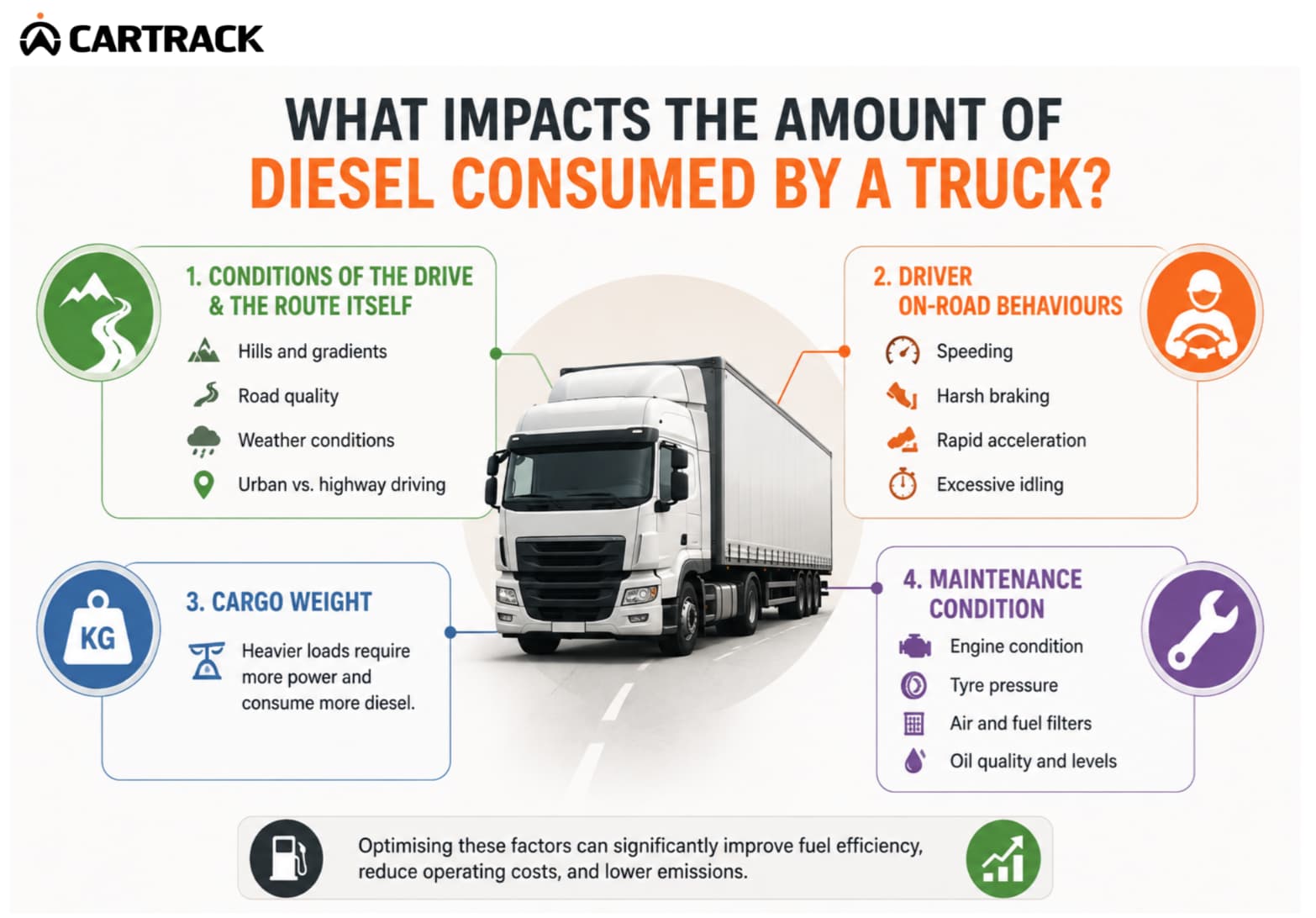
Let’s take a closer look at these variables:
Whether we’re looking at ever-changing traffic patterns, weather, or road conditions that truck drivers deal with daily, these all impact fuel consumption. Did you know that intense rainy weather can increase fuel consumption by 15%, and extreme cold or icy roads can DOUBLE fuel use? This just highlights the importance of incorporating weather planning into route optimisation.
Traffic and road congestion are another issue. The stop-and-start action of being stuck in traffic, as well as the consistent gear, speed and shift changes, massively waste diesel. Calm, flat highway driving is also far better than taking mountainous routes. Much like bad weather, treacherous terrain also sees your fuel consumption increase significantly.
Route optimisation is your solution to all of these factors. An effective fleet system will use AI algorithms and automation to produce the best routes, taking into account weather, traffic, and landscape.
How your drivers behave on the road is one of the most influential factors contributing to diesel consumption. Research shows that maintaining the cruising sweet spot between 80 and 90 kilometres per hour is the best for a truck’s fuel economy, in comparison to higher speeds.
If drivers are driving aggressively, idling excessively and practising other wasteful habits while driving, you could see a dramatic 15% to 30% increase in fuel consumption across your commercial fleet.
Driver coaching and gamification are some of the best strategies here. When your drivers correct their bad habits, you’ll quickly see even the smallest changes make a difference. A good example of this is the adoption of cruise control; when truckers maximise this technique along highways, they reduce fuel consumption by up to 7%.
We’ve all experienced the tough, exhausting road trips where the car is weighed down by everyone's heavy luggage in the boot. The same applies to trucks carrying heavy loads, which is why weight distribution is critical here.
Heavier cargo already affects fuel consumption, but unbalanced cargo actually puts strain on your axle and forces your drivers to use more fuel to accelerate. An effective fleet system with specialised sensors can use its analytics to ensure load volumes and cargo capacities are compliant.
If you’re dealing with a truck that’s been poorly maintained, you could easily be looking at significantly increased fuel use from your trucks just trying to perform optimally. The US Department of Energy tells us that using poorly maintained trucks can increase fuel consumption by up to 15%.
Preventative maintenance in a fleet system can keep you privy to maintenance schedules before any breakdowns even happen. This keeps your truck operating in top shape and your fleet’s fuel consumption well managed.
Yes, Cartrack can help you reduce fuel usage in your truck fleet with the help of our array of smart technologies. Internal data shows that with the help of FleetWeb’s fuel management tools, your business can cut its litres per kilometre travelled by 23%. Additionally, overall fuel consumption per vehicle per month can be reduced by 90 litres!
👉 All the solutions mentioned in the previous section are offerings that Cartrack can provide so you can meet your fuel efficiency goals! 👈
Here’s what our fuel solutions can do for your business:
With our route optimisation feature, your drivers are taking the best routes for their jobs. Our system will automatically give your driver a route that’s efficient and optimised, minimising the overall mileage travelled by your fleet.
FUN FACT: One of our partnering businesses saw a saving of 165 litres of fuel across four commercial vehicles; this was achieved in a period of just 10 days!
You can also ensure jobs are being carried out as they should be and that your drivers remain accountable. Check your trip histories to ensure your drivers aren’t deviating or taking wrong, longer routes, and see if anyone is using the truck without permission.
If there are sudden unexplained drops in fuel levels (suggesting fuel fraud or syphoning), you’ll immediately be notified. You’ll be able to quickly check fuel levels via the graph that displays the fuel probe readings. We also have automated fuel card checks, ensuring the transaction from the fuel card and what’s reflected through telematics match.
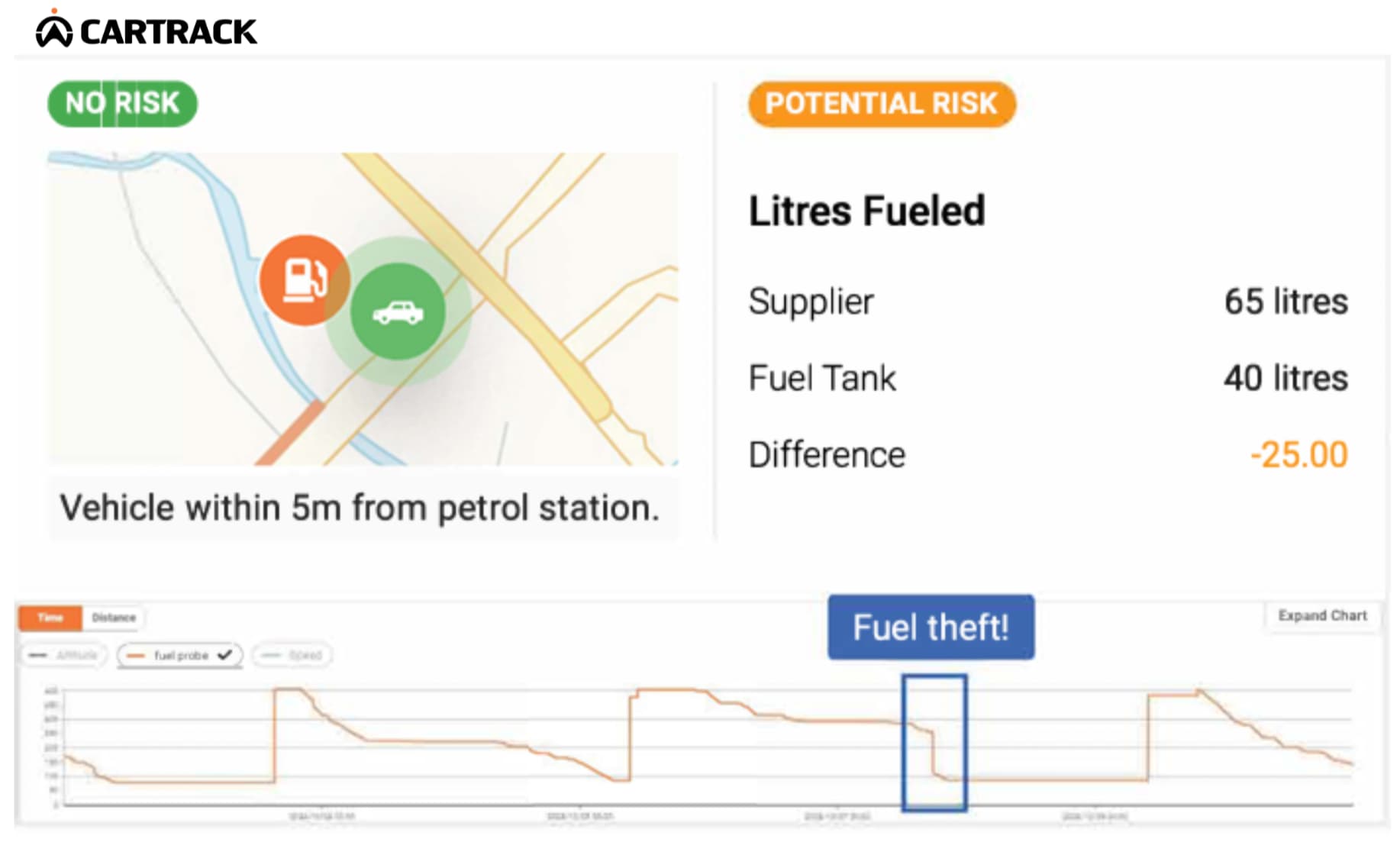
Closely analyse detailed fuel reports to check that transactions and consumption match what’s being reflected through telematics. You can look over a comprehensive fuel report or use our odometer reports to get more accurate mileage figures.
You can also use logbooks or times-operated reports to distinguish between personal and business fuel consumption, so you know which is which.
Bad driving habits don’t have to stick around in your business. Our AI camera systems alert drivers to their distracted or aggressive driving, audibly notifying them when they smoke, speed, use their cellphones, exhibit exhaustion and other risky behaviours.
Keenly monitor your drivers and how they’re behaving on the roads. If your drivers are exhibiting poor, fuel-wasting driving behaviours and typically reoffending, you’ll be able to see those ratings via scorecards and real captured footage.
You can also use the data as an opportunity to incentivise and promote drivers that are practising safe driving.
Whether you’re managing a fleet of light delivery vehicles or heavy-duty long-haul trucks, every single kilometre counts. Having a clearer understanding of where your diesel spending is going can help you improve the outcome of your profits, which is why having total visibility on fuel consumption can change the game.
With a platform like FleetWeb, you can easily identify the leaks, inefficiencies and lapses so you can turn those losses into long-term wins.
Put the brakes on wasted fuel. See how an intelligent fleet management software package can completely transform the consumption of diesel in your fleet. Give Cartrack a call and start saving today!

Track your fleet’s fuel usage. Discover how much diesel a truck uses per km and learn actionable ways to cut consumption & lower operational costs.