
Charging your electric car in South Africa costs about R4 per kWh when charging on-site, and around R6-7 per kWh when charging at a public station. As infrastructure improves, owning EVs becomes a more attractive option for motorists. Range anxiety used to be the main concern for South African EV owners, but we’re quickly seeing that change for the better.
Recent updates from MyBroadband and Clean Technica reveal that South Africa has surpassed 500 public charging stations. Just under 100 of those are free chargers across popular national shopping centres, dealerships, and even hotels & resorts. The expansion is evident; EVs are quickly becoming a regular part of our lives, fully integrated into the places where we work, shop, and travel.
Don’t get drained trying to find all the answers to your EV charging questions. Learn about EV charging prices, whether in-house or public chargers are best, and how Cartrack can help you manage your vehicles to keep your battery in top shape.
The cost of charging an electric vehicle depends on the make and model (and ultimately the vehicle’s battery size), where you charge it, and the electricity rates. Generally speaking, though, fully charging your electric car will cost anywhere between roughly R250 in-house and upwards of R500 in public.
In-house/on-site is considered the most cost-effective option. Although commercial electricity tariffs might differ from those of residential areas, they’re still typically more affordable than public charging stations.
Let’s dive into the nitty-gritties:
In-house charging (also known as depot charging) is the best route for your business, with charges running at about R4.50 per kWh.
It makes the most sense to have chargers installed on your business premises, and according to Rubicon, your commercial tariffs remain pretty low. You don’t have to worry about extra usage fees, and your biggest concern is only the initial cost.
As is the case for EVs in general, the initial investment can be quite jarring, but the eventual savings in running costs will make up for that. If we look at a level 2 charger with a likely 4-10 hour charge time, expect a minimum total of about R25 000 for the complete setup, with the potential for prices to reach around R45 000.
Setup includes factors like:
But if you opt for solar energy as a means to keep your chargers powered, you can bring your running costs down even further.
The South African government continues to support clean energy sources through tax incentives. According to section 12B, you can quickly deduct the cost of your systems (solar panels and supporting structures) from your income tax.
You’d effectively fund your transition to a solar-powered electric output through the government!
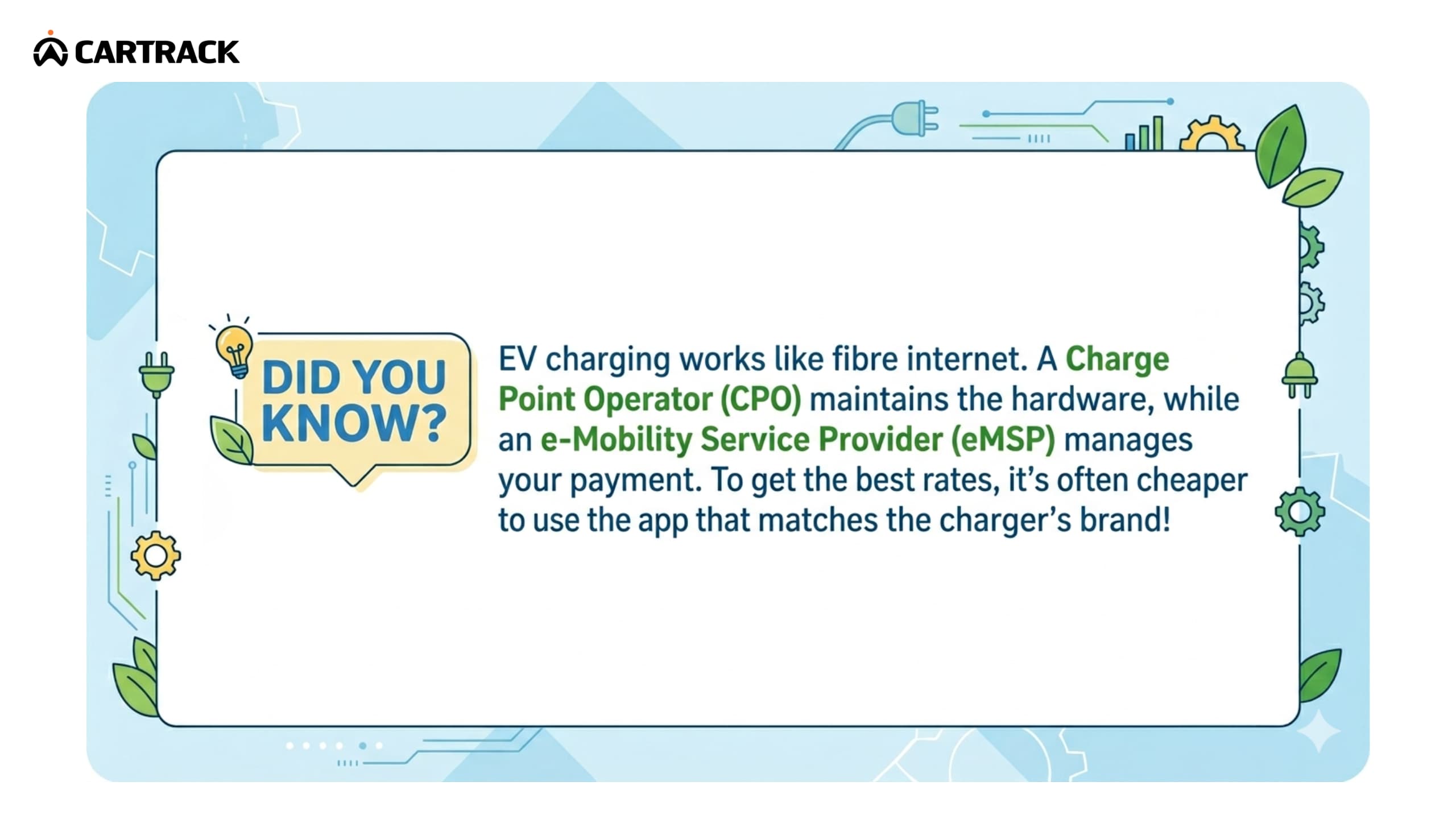
Depot charging means total operational readiness, getting rid of the massive downtime that would come with waiting (and wasting) valuable time at public chargers.
Charging your EVs at public stations is always going to be more expensive, sitting at around a steep R7.50 per kWh. This is unless you find yourself near one of the over 90 completely free charging stations across the country.
While the free charging stations are appealing, they’re also slower, and your business runs on tight delivery and service windows. The reality is that you need to factor in the premium public DC fast charger rates (+/- R7.50 per kWh) for emergencies and stops that occur away from the depot. These chargers work at lightning speed, getting most EVs charged to 80% in under 45 minutes.
Want to know more about where to charge publicly? Check out our summary below:
Yes, there are additional considerations when it comes to public chargers.
Some of these include:

No, there aren’t necessarily subscription fees for accessing public EV charging points in South Africa, but there are some membership and direct payment options you can use.
When you opt for a membership structure, you can choose a provider that allows you to top up money to the membership account/wallet so you can easily pay across numerous charging providers. Memberships are typically annual.
When you opt for a direct payment option, you can choose to directly tap your bank card as a means of payment instead of using a wallet, pre-funded card, or anything that needs you to create an account. Direct payments are quickly being integrated into most EV charging networks.
Cartrack can help you manage electric vehicle efficiency by helping you monitor battery usage, keeping track of driver behaviour, providing route optimisation, and so much more. Each of these contributing tools and technologies has a role to play in keeping your battery at optimum health.
The key rule to remember is: battery health is influenced by more than charging alone.
We understand that charging costs matter, but we also believe how your vehicles are driven & used holds just as much weight, and is crucial to maximising the return on your electric vehicles. Let Cartrack help you carefully monitor your EVs and keep them (and their batteries) in tip-top shape.
With FleetWeb, here’s what we have to offer YOU:
When you have a close eye on vehicle and battery usage, you get a clear understanding of vehicle patterns and the habits or actions draining your EV batteries. Monitor energy usage and charging frequency more effectively with data-driven insights into how often your EVs need to be charged.
When you adopt a fleet management platform like ours, you get complete visibility into battery consumption and charging patterns. Having these insights means you can take the necessary steps to avoid ‘range anxiety’ issues, tackle battery-wasting practices, and ensure your EVs are always charged optimally.
Smart, detailed insights = transformative, data-led business changes.
Businesses love route optimisation, whether the fleet consists of traditional vehicles, EVs, or both. Our platform adopts AI, real-time tracking, and algorithms to provide the best paths for each of your drivers, taking considerations like traffic and potential roadworks into account.
Improve your EV’s range efficiency by cutting down on unnecessary kilometres with smart routing, and stay closer to available charging points. Protect your battery life by reducing excessive stop-and-start driving habits.
When you have refined, optimised, and carefully planned routes, there’s less battery waste and more distance achieved per EV charge.
Did you know that reckless driving by your staff could dramatically drain EV batteries? Much like a traditional vehicle quickly losing petrol in this manner, aggressive and poor driving habits can add a great deal of strain.
Thanks to our driver monitoring systems, you can have oversight of your drivers and keep a scorecard of their driving behaviours. From excessive idling to speeding, these actions cause serious battery depletion.
Use the feedback from our driver monitoring solutions to quickly correct inefficiencies and get back to increasing EV driving ranges.
Optimised workflows and fleet operations bring it all together. With our platform, you have total fleet visibility, allowing you to carefully plan charging schedules and carefully plan which vehicles should and shouldn’t be in use. This massively reduces downtime, bringing about fleet EV asset balance.
When your EV fleet operations are moving smoothly and with precision, the EVs in your fleet are being used accordingly, and you can avoid charging delays.
There’s never been a better time for you to focus on the electrification of your fleet. South Africa’s taking a hugely-accepting turn when it comes to the adoption of EVs, putting us on a future-forward path.
But remember: while grasping the price and factors behind EV charging is important, don’t overlook the how and where of your energy consumption. This is where your business earnings lie, and this is where Cartrack can help you flourish.
Don’t you think it’s time you took charge of your fleet? Request a Cartrack FleetWeb demo today to see how you can propel your fleet into an electric, money-savvy future.
Calculate your savings. Discover the true cost of charging an EV in SA – from home rates to public DC fast chargers – and see how they compare to petrol.