To go from reactive to proactive safety in your fleet, you need to invest in an advanced telematics system with AI cameras. An advanced telematics system uses predictive maintenance to let you know what’s happening with your truck's mechanical side, while AI cameras show you how your drivers are behaving behind the wheel.
It’s Monday morning, and just before you’re about to take a sip of your coffee, your phone rings—one of your trucks carrying really expensive cargo was just in an accident because the brakes failed.
Now the absolute nightmare begins between your client waiting on their shipment, making sure your driver is okay, calling your insurance company and dealing with the police. If this sounds familiar or like something you’re constantly anxious about, it’s time you move from reactive safety in your fleet to proactive safety.
According to a report by the Department of Transport, road accidents drain around 2.7% of South Africa’s GDP every single year. This accounts for R205 billion in costs for the country—which further proves that switching from a reactive to a proactive system is not only beneficial for your operations but for the economy too.
So what do these economic issues have to do with fleet owners in the B2B industry? Well, this can increase your insurance premiums—costing you more in the long run. So, if you’re interested in shifting your entire fleet from a reactive mind-set to a proactive one, you need to focus on three things:
This blog breaks down exactly how to change your 'wait for the shoe to drop' method to making sure those shoelaces are tied in a neat little bow, never unexpectedly making you trip.
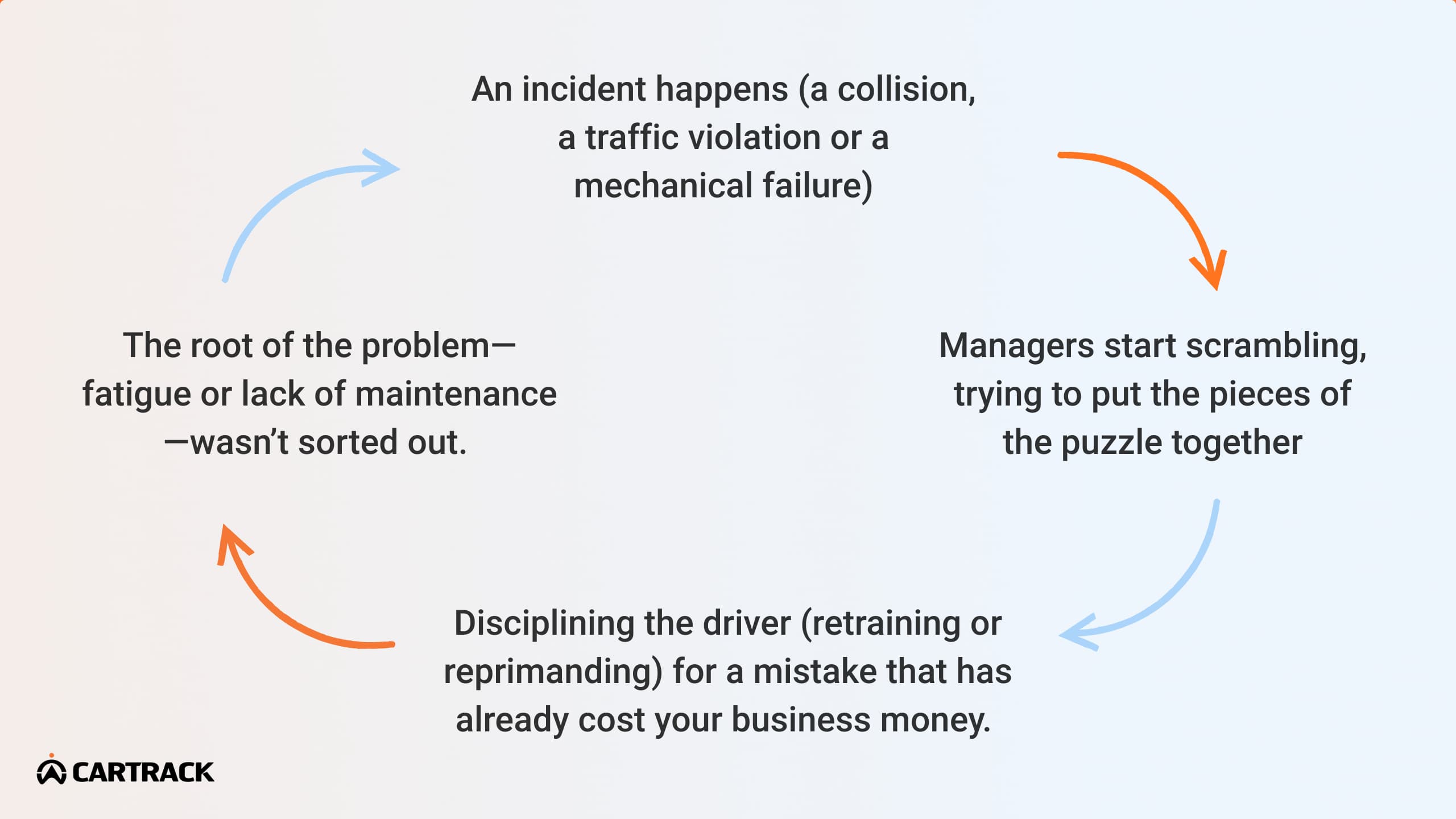
Businesses that don’t have proactive safety measures in place are often stuck in this reactive cycle. The cycle starts with an incident happening and your team working to find out what exactly happened. Then managers start reprimanding drivers, and at the end of the day the root of the problem hasn’t been sorted out, so the cycle starts again.
What fleet managers and business owners need to understand is that the main risk to your business is not higher insurance premiums, unexpected maintenance costs or downtime. The biggest risk to your business with only having reactive fleet safety in place is the damage it’ll do to your brand image and your drivers' wellbeing.
The proactive safety approach is when you have tech like dashcams and advanced telematics installed in your fleet that helps in preventing accidents or unexpected breakdowns. This approach is the best way to keep your business profitable, your drivers safe and your clients happy.
Imagine you’re at work on Friday afternoon after a long week, and you have exactly 5 mins before you clock out for the day when the phone rings… You’re hoping it’s just your wife calling you, asking to get some bread before you come home. Unfortunately, it’s the police calling to let you know that your 18-wheeler truck was just in a major accident and your driver (who has been with you for the past 6 years) has passed away.
The brakes of your truck failed. It crashed on a downhill into another car, and there are multiple fatalities. The worst thing that can happen has officially happened, and it could have been avoided, but your fleet isn’t equipped with proactive safety tech. Now, you’re dealing with insurance, the police, a lawsuit, and a grieving family and team.
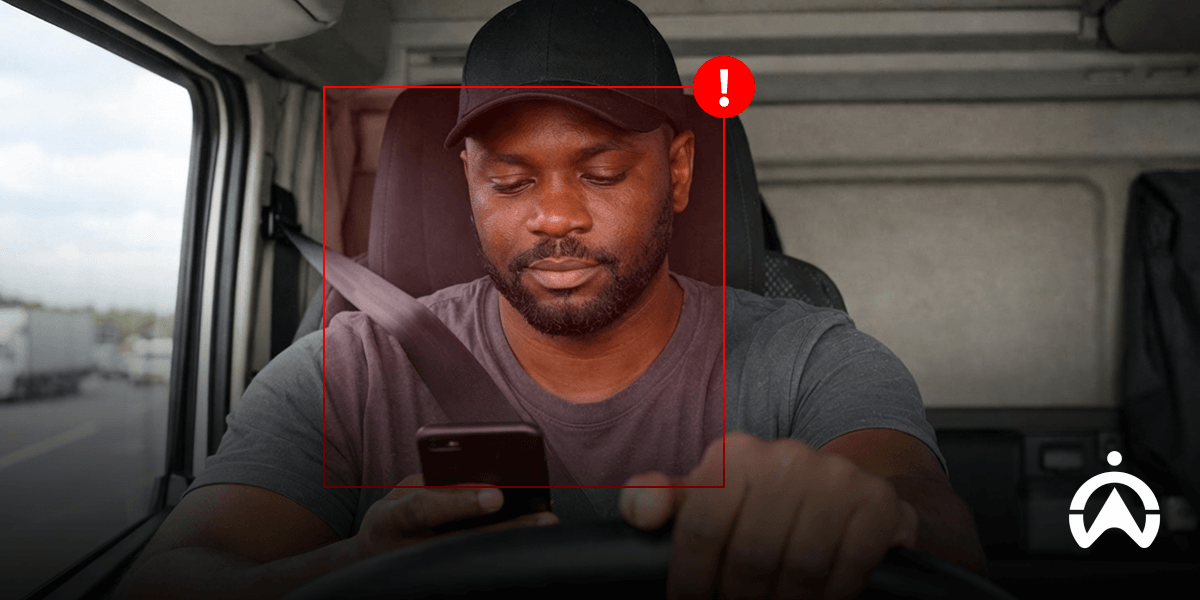
Having a telematics device installed could have alerted you two weeks ago that the brakes on that truck needed to be replaced and that your driver was constantly speeding. So you could have had time to change the brakes and coach your driver on his bad speeding habit, preventing all the events that followed.
There are three main characteristics to having a proactive fleet; these are predictive intelligence, condition-based maintenance and having a coaching-first culture. When you implement these three things in your fleet, you improve the safety of your vehicles and your drivers, and overall, you improve your ROI.
Instead of you looking at GPS breadcrumbs to see where a driver was when they were speeding, a proactive fleet uses AI to monitor micro-behaviours.
A proactive fleet doesn't wait for the check engine light to go on or for a driver to report a "funny noise".
So instead of just dishing out warnings left, right and centre to your drivers who make mistakes. Rather take the data you get and proactively coach your drivers to create better driving habits.
The biggest hurdle you’ll probably face with introducing proactive safety measures in your fleet is pushback from your drivers. They might feel like you don’t trust them or even feel uncomfortable being constantly “watched”. The solution to this is transparency.
Here’s real video footage from a Cartrack dashcam of a recent accident that helped prove a trucker’s innocence in a fatal accident:
Cartrack can 100% help you with proactive fleet safety thanks to our years of experience and world-class technology. Features such as AI-powered visibility, real-time coaching, predictive maintenance and driver scorecards all help to move your fleet from a reactive one to a proactive one.
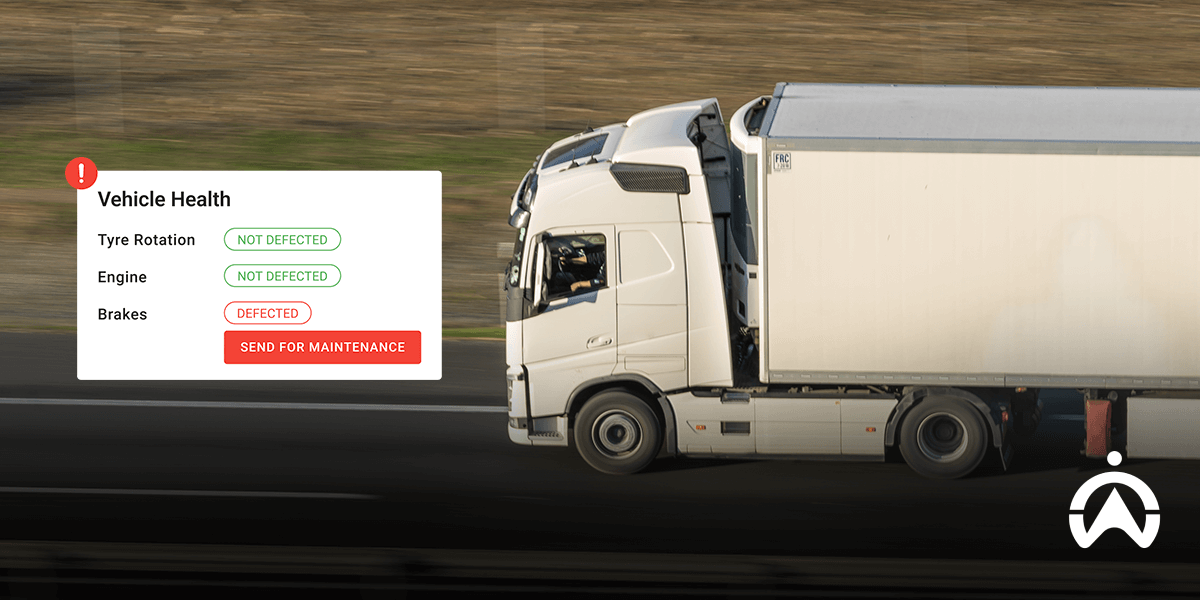
At Cartrack we have some really high-tech AI-powered cameras that will be the backbone of your shift to being proactive with safety in your fleet. This is because our cameras process information super fast and will be able to not only alert fleet managers of these events but also immediately alert the driver so they can self-correct.
If you don’t get real-time alerts to risky driving behaviours and your system only tells you once you pull a report, you can only coach your driver after they’ve done something that has put their life and the lives of others at risk.
This is basically pointless. Having a system that alerts you and your driver immediately allows both of you the opportunity to fix the problem while it's actually happening. Not only can you correct behaviours, but it can also give you valuable insights into your drivers.
Let’s say you review footage and reports, and you see that every Wednesday, over the past three weeks, your driver David is constantly yawning and showing exhaustion (which is a safety risk). You’re now able to discuss with him that this is a pattern you’ve noticed and find out what’s going on in order to find a solution that works for both of you.
The result? An employee who feels seen and taken care of, and the peace of mind knowing that no accidents are going to happen because of David dozing off behind the wheel.
One of the biggest struggles you’ll have with a reactive strategy is getting your drivers to make safer habits while on the road. A proactive approach will help with this. At Cartrack we’ll provide you with a fun tool called ‘driver scorecards’. This will help you, as the fleet manager, see where your drivers are going wrong and can let your drivers actually see how many times they’re making the same mistakes.
This approach will create a culture shift when it comes to safety and how unsafe driving is handled.
First, all your drivers start off with a score of 100, and then points are deducted based on the infraction that occurred. What this means is that a driver with a low score is your higher-risk driver and is a hazard to your operations.
Another bonus is that as the fleet manager, you have the power to create your own rating system, so if you feel that distracted driving (like using the phone or eating while driving) is a very high-risk event, you could make the rating for this 35, while harsh acceleration to you is considered a low event and has a score of 1.
Having these scorecards shouldn’t be there to stress you or your drivers out. It should work as a tool that helps to bring awareness to bad driving habits and helps your team to want to be safer on the road.
Ultimately using driver scorecards will benefit the company as a whole, because if your drivers are driving well, it’ll build a positive brand image around your trucks (who notoriously have a bad reputation on the roads).
People love rewards. When you incentivise good driving, you’ll have more good drivers. So think of an incentive that works with your drivers, and let the healthy competition start.
Types of incentives could be:
By adding gamification into your fleet, your drivers will be motivated to have better driving habits, without the constant need of management keeping them in check. Gamification and scorecards will help keep your cargo, trucks and drivers safer.
Fun fact: the scorecard is free with all of our fleet management systems!
Proactivity can improve your business’s ROI by lowering the chances of accidents and breakdowns that all drain profits. According to industry data, reactive fleets are 65% more likely to experience a crash compared to those who have proactive safety systems in place.
To help you visualise all this, think of the Heinrich Pyramid. This pyramid is based on the law of probability: “In a workplace, for every accident that causes a major injury, there are 29 accidents that cause minor injuries and 300 accidents that cause no injuries.”
And we can look at this with your fleet as well; for every one major accident that happened, there were 300 near misses. Having proactive safety measures in place focuses on the 300, making sure that 1 never happens.
To make all of this wonderful but weighty information just a little more digestible, here’s a fictional but very probable story of how switching from a reactive fleet to a proactive fleet with Cartrack can improve your business. This is a story of a logistics company called Mobile Movers (a made-up example of a Cartrack client).
Mobile Movers has been experiencing constant issues with their fleet, from speeding tickets and drivers who are constantly quitting to unexpected downtime from random breakdowns. All of these lead to the company losing time and money.
They then decided to sign up to get Cartrack’s telematics tech, which is linked to the vehicle’s CAN-bus system and AI Live Vision cameras. Now they have predictive maintenance that alerts the fleet managers of everything that’s happening with the vehicle and when they should book the trucks in for a service.
With the AI cameras, the fleet managers can now see what’s happening in and out of the vehicle. Their drivers can now prove their innocence in an accident and have the ability to self-correct when they make a mistake on the road, like being distracted or falling asleep.
Thanks to driver reports, fleet managers can now support their drivers and positively coach them to make safer driving habits and implement gamification to incentivise better driving. This proactive approach has made the drivers at Mobile Movers feel seen and protected, meaning that fewer drivers quit and chose to stay where they were seen as a person and not a number on a sheet.
Having a proactive safety system in your fleet is a sure way to have a competitive advantage—of certainty at least. If your fleet is waiting to react to problems as they arrive, there’ll be an endless list of problems every single day.
But when you handle the safety of your fleet proactively, your list basically becomes nonexistent because you can see a problem from a mile away and stop it in its tracks.
So don’t wait for the call of the next incident; call Cartrack and let us help your fleet see around the corners.
Stop waiting for accidents to happen and start preventing them with smart telematics, real-time coaching, and predictive maintenance for your fleet.