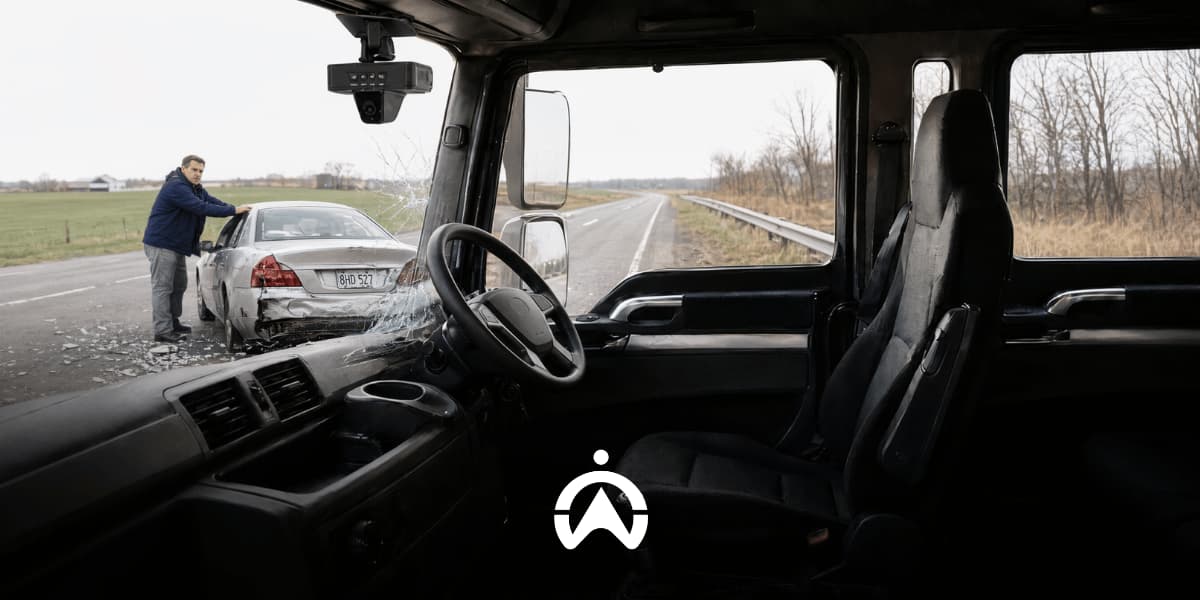
As much as you try to prevent your drivers from getting into road accidents, they remain a reality. But part of mitigating corporate risk is knowing how to exonerate your drivers when they claim to be in the right. Prevent those pesky, drawn out he-said-she-said arguments and get proof that your drivers follow the safety practices you’ve spent so much energy training them on.
The best way to investigate a fleet accident is by combining dual-facing dashcam video footage with telematics vehicle diagnostic data. This provides objective, timestamped evidence that reconstructs speed, braking, vehicle location, and driver actions immediately prior to impact.
Telematics comes in the form of vehicle location, vehicle behaviour, video footage, and driver behaviour. All of these provide context for the accident that took place and help you form a picture of what happened—and who was to blame.
The most compelling digital evidence for exonerating a driver is vehicle video footage. Dashcams give you, the police, your insurance company and the RAF a precise version of events such as who neglected to follow the rules of the road, and whether an external factor played a role in the accident.
A driver should always keep a calm demeanour after an accident so that they can think clearly and not provoke the other party. They should also alert for help with a physical panic button or through the Cartrack app to notify the fleet manager and Cartrack’s emergency control room. Subsequently, they should check for injuries, take photos of the scene, and jot down all personal details of the parties involved and all eye witnesses to the incident.
Yes, dashcams are one of your surest strategies for exonerating your drivers if they maintain that they did nothing wrong to cause the accident. Fleet cameras from Cartrack provide road-facing evidence of the accident, and can also record the driver simultaneously. More advanced packages even record footage around the vehicle, like the back and the sides.
A dashcam is very helpful after an accident because it captures events that might later be denied by the other party. With this footage you can prove who’s lying about what happened and save yourself thousands in repair costs and insurance excess.
Yes, insurance companies do view dashcam footage to get a clear picture of what happened and corroborate stories from all parties involved. They understand that people often withhold the truth or lie about accident events to get out of paying for their mistakes.
Fleet managers should retain accident dashcam footage for at least 2 to 3 years to account for legal prescription periods and delayed insurance or legal claims. In South Africa, third-party civil claims and RAF proceedings can take months or years to initiate, making long-term cloud archiving essential. It’s wise to keep dashcam footage for at least 2 years after a road incident like an accident or road rage event. For legal purposes, this footage might be brought into question during a court case or to settle an insurance claim months down the line.
For fleet management, AI dashcams are the best option, because they not only record the events of accidents, but even attempt to prevent them from happening in the first place. Voice alerts will detect fatigue, distraction and cell phone use during driving and warn the driver to correct their behaviour in real time.
Yes, Cartrack’s dashcam comes with smart AI voice alerts to prevent accident-causing behaviour, and it provides the fleet manager with a live feed for direct footage of what the driver is doing and seeing at the same time. This method of manager-to-driver communication has stopped countless fleet accidents in South Africa, so every company that uses vehicles should have them.
Cartrack monitors driver behaviour in three ways:
Yes, when coupled with fleet software, a GPS tracker can detect & record speeding and other bad driving habits. It archives these events into easy-to-read reports and allows fleet operators to manage their driver coaching more effectively.