You need a dedicated fleet manager when your fleet starts to grow beyond the size of about twenty to twenty-five vehicles. A fleet business typically starts small, and an employee who’s good at handling logistics might be given the responsibility of handling the fleet. But what happens when there’s significant growth? Handling a fleet part-time works right up until it doesn’t.
Knowing which direction to take can become a truly daunting task that raises more questions:
Ultimately, there isn’t a one-size-fits-all approach. Assessing your options can help you find the best business fit.
To figure out where your business sits, keep reading this guide. Learn when (and if) software is enough, when a full-time fleet manager is necessary, when a combination of both works best and why Cartrack is your top fleet software partner.
Your fleet typically calls for a dedicated fleet manager when it hits around twenty or more vehicles, but fleet size shouldn't be the only factor in making that decision. It’s based on complexity. If an employee has successfully taken on the additional role of fleet manager alongside their regular role, then you might not need a dedicated fleet manager.
But when the work starts to pile up and admin slips through the cracks, you may want to reconsider.
This is why determining whether a full-time manager is needed or not is less about the number of vehicles in a fleet and more about how the fleet operates. For example, fleet A has 10 vehicles, but one or two drivers are doing short, local trips. Fleet B has 10 vehicles and also 10 drivers, doing extensive routes with tight delivery windows.
Let’s break it down:
When it comes to fleet operations complexity, what drives your management needs includes:
Looking at these points is a clear indicator that it’s not just about how many vehicles there are but rather the daily decisions that need to be made for the fleet.
A fleet manager is actually responsible for keeping every aspect of the fleet running safely, smoothly and cost-effectively. “Every aspect” includes the drivers, vehicles and trips. Fleet management extends beyond just scheduling and monitoring fuel, and in practice, five core areas need to be covered.
Each of these core areas is manageable on its own, but when they come together, that’s when the real workload begins to pile up.

Fleet software can be enough for small fleets, as long as someone is still there to make the necessary decisions. Small fleets rarely need a dedicated fleet manager, so it’s not the first thing they’d need, but what they do need is VISIBILITY. You must know where your vehicles are, when the next service is scheduled and how they’re being driven.
This is when fleet software truly shines.
You wouldn’t need to focus on spreadsheets, loose papers that can get lost, phone calls, or even estimations; nothing would slip through the cracks. A platform like Cartrack’s FleetWeb would keep track of your vehicles, detailed trip histories, driver logs and other reports, so that monitoring takes minutes, not hours.
Unfortunately, a smaller fleet doesn’t necessarily mean less risk. According to the Department of Transport, the 2025/26 festive season showed that light delivery vehicles were involved in 20% of crashes. Most small fleets depend on light vehicles for their services, so safety and driver monitoring remain on the agenda even if there isn’t a dedicated fleet manager.
The catch is that software reduces and simplifies the work but doesn't remove it. Someone still needs to engage with and report on the fleet’s progress, and in a small fleet, an employee or owner can do that alongside their main role. This is why software is often enough at this stage.
Medium fleet management is where the gap between having data and using it for business decisions starts to show. This is likely when your operations begin to grow enough for you to see the cracks in fleet management: late deliveries, breakdowns and expired renewals are growing in frequency.
Even though the fleet software is doing its job and supporting all workflows, the problem then becomes that the person handling the fleet is still handling other work.
This is usually reflected in the following ways:
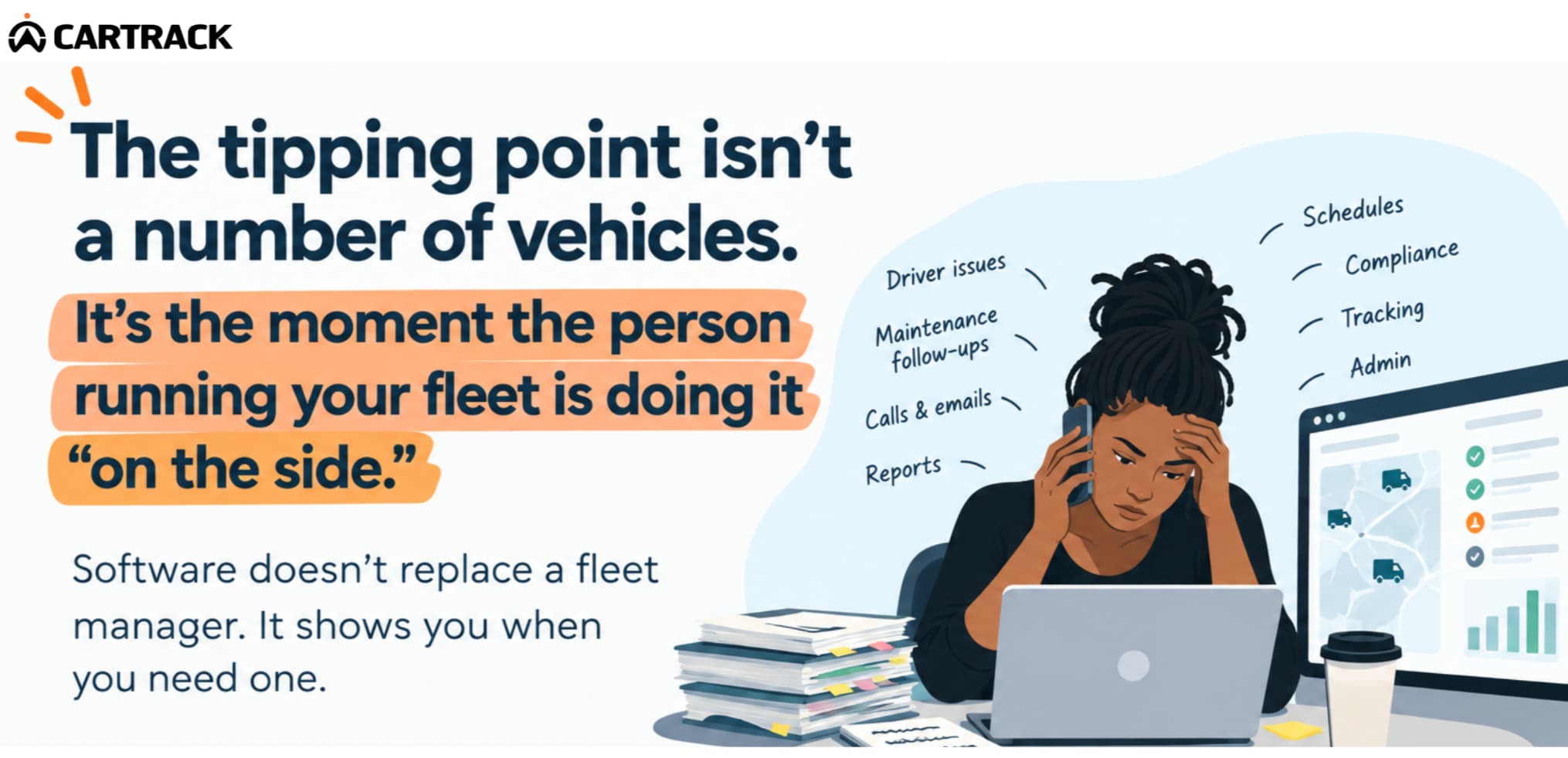
Instead of asking, "do we have enough vehicles to justify a manager?" ask, "is handling the fleet tasks now taking more time than the person doing it can even spare?"
If your answer to this is yes, then it might be time to decide whether you invest in a permanent fleet manager or you opt for outsourcing one.
Large fleets need a manager and software combination because neither can survive on its own. Large fleet operations usually work on a much bigger, more complex scale that involves various regions, numerous depots, hundreds of vehicles and more. The day-to-day operations simply can’t be followed by the eye.
A manager without software works with unfinished data. Software without a manager produces deeply detailed insights with nowhere to go and no accountability. But when they come together, the work is split sensibly.
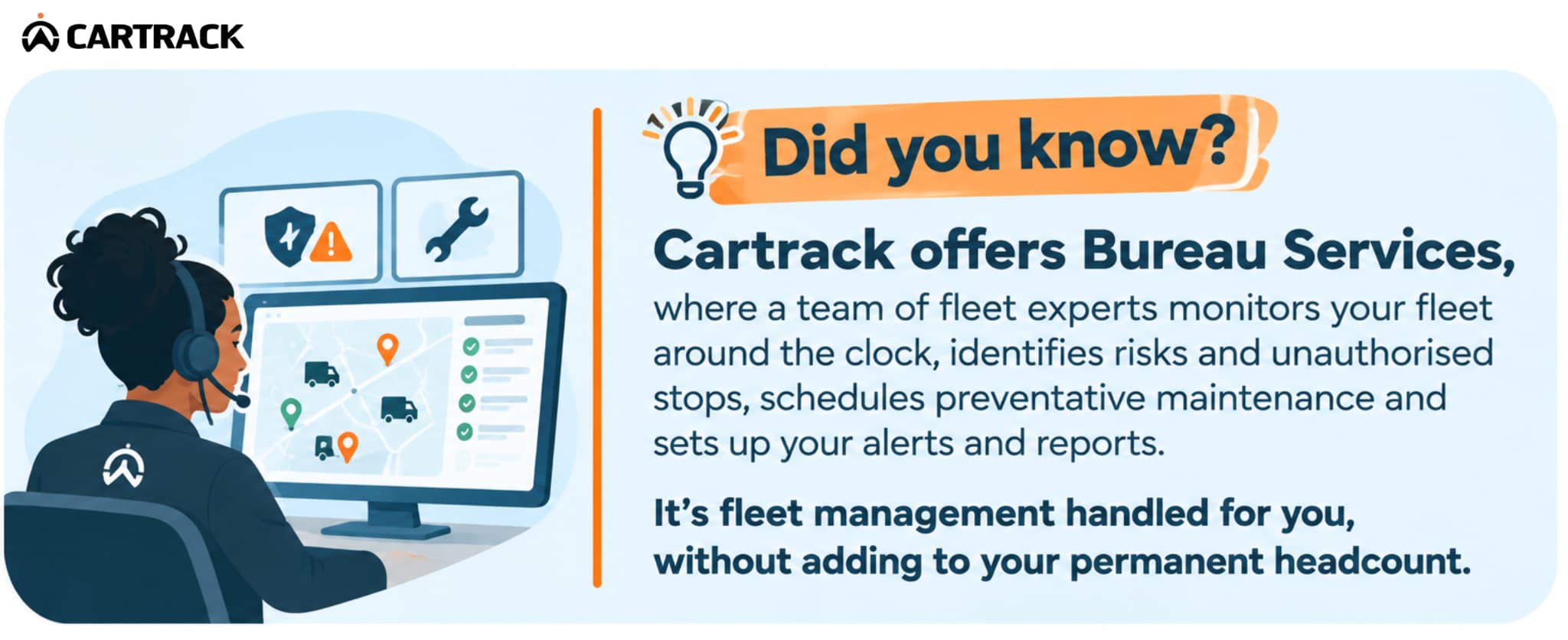
The middle path when it comes to fleet management is fleet bureau services, the third option that sits between software alone and a full-time fleet manager. Fleet bureau services are when you outsource fleet management, getting a fleet manager who’ll work on the day-to-day management of the fleet on your behalf.
The work is getting done, but you don’t have to worry about dedicating a permanent spot on payroll.
Ultimately, the scope varies from provider to provider, but the fleet management bureau services cover the same responsibilities, and you’d choose how much of those responsibilities you’d give to the outsourced fleet manager. It’s often a great option for businesses that have a medium-sized fleet and have outgrown a part-time manager but can’t justify a dedicated hire.
Sometimes, the workload might get a bit too much over peak seasons, or you just want fleet management expertise for your business without having to start from scratch with training and preparation. But the most important part of a bureau is that fleet software doesn’t replace their work; they MUST work together for optimal results.
Take a look at what you trade off between bureau services and a dedicated manager:
The choice ultimately rests in your hands. You decide how much of your fleet operations are shared and how much you want to keep close. A useful test is the number of hours the work actually takes, which software can show you.
Cartrack’s fleet management software helps support fleet managers by providing the best in fleet software for fleets of ALL sizes. It has all the features and benefits a fleet could look for, turning day-to-day activity and insights into information that’s useful to business growth.
Our fleet software, FleetWeb, is also scalable with your business, so you don’t have to find a new provider as and when your business grows. We’ve been supporting businesses for over 20 years with a platform that’s built around all the responsibilities we’ve previously covered.
Earlier in this guide, we covered the five core areas that need to be covered in practice. Here’s how Cartrack meets every single one of those areas:
✅ Daily operations and visibility
Live GPS tracking and trip histories will show you where your fleet vehicles are at all times, so you don’t have to chase drivers for updates. Cartrack’s GPS works using numerous cellular networks, ensuring the connection almost always remains stable. The dashboard and mobile app keep you connected to your fleet with instant alerts, no matter where you are.
Urgently need a report? You can quickly export a report on almost anything you need, filtering accordingly and choosing between Adobe Acrobat Reader (PDF), Microsoft Excel (xls) or Microsoft Excel xlsx formats.
✅ Effective cost management
Our MiFleet feature is the expense and cost tracking part of FleetWeb, allowing you to monitor everything from fuel, tolls and fines to maintenance and insurance. You can review, cross-reference and identify transactions while also seeing where your fuel is going and if there’s potentially fraud or theft occurring.
All of this gives you the hard numbers you need to have better and more controlled management over fleet costs.
✅ Maintenance
We offer predictive maintenance to keep your fleet operating optimally. With preventative maintenance, you’ll be notified of upcoming servicing or repair dates based on usage and manufacturer guidelines. This ensures that handling maintenance shifts from being reactive to proactive, massively limiting downtime and loss of business revenue.
✅ Driver management
We offer fully-fledged driver monitoring systems to ensure the safety of your drivers and those around them. We offer AI-powered camera systems that detect fatigued and distracted driving, alerting drivers in real time if they trigger said events.
They can be linked to driver scorecards, so you can effectively rate how your drivers are behaving on the roads and coach them based on personalised feedback.
✅ Compliance and safety
Stay on top of all the necessary documents you need to keep the business running. Licences, renewals, vehicle discs, roadworthy records and more can all be kept up to date; our platform will notify you when expiry dates are approaching. Your business policies and safety guidelines can also be kept up to date, especially considering that safety regulations are consistently changing.
We also offer the opportunity for you to digitise your pre- and post-trip inspections for your drivers, so you can further enforce a culture of safety.
A perfect example of what Cartrack’s business partners see in practice comes from a case study with Mr Build. Mr Build has seven branches across the country, totalling up to about forty fleet vehicles.
Placed firmly in the medium fleet category, day-to-day management means that there are plenty of vehicles on the road and a dedicated manager who needs to know where they are.
“Cartrack helps [me] to monitor the fleet much better, because I always know where all the vehicles are. There’s no part of the day where I have to look for a vehicle or look for a driver, and if I can’t get a hold of a driver, I know where his truck is." - Mohammed Haidar Yacoob, Manager
Mohammed mentions two crucial points that are important to him and his fleet:
This is a prime example of the software at work. But while it’s finding and flagging, it can’t decide on the next steps.
Do you follow up with the driver? Should you change the route? Maybe you need to urgently call roadside assistance? These are all the decision-making tasks required of a fleet manager (whether in-house or outsourced), and the kind of questions that’ll always need human guidance.
Watch the full testimonial 👉 here 👈.
Matching your fleet setup to your fleet isn’t just about its size, because the truth is there's no magic number of vehicles at which you suddenly need a dedicated fleet manager.
Take a step back and look at how your fleet is currently being managed. If the alerts and tasks are piling up faster than someone can act on them, then it's time to add additional resources, whether in-house or outsourced. Either way, a fleet management platform gives that person the ability to make the right call.
See how Cartrack's fleet management platform gives you the visibility to decide and the support to act on it. Call us today!
Learn at what fleet size a dedicated fleet manager becomes essential to control rising maintenance costs and operational risk.