Millions of South Africans depend on public transport. For public transport fleet operators this means they need to ensure their fleets are running as smoothly as possible. With real concerns and problems around safety, efficiency, compliance, and commuter demand, the need for a fleet management system for public transport is high.
South Africa has various public transport options, each managed differently. An operator running scheduled buses under a contract has specific duties compared to one managing minibus taxis with no formalised reporting regulations. And this is exactly why fleet management is crucial in this industry.
But both of these fleets are exposed the second something goes wrong on the road, and without data, they’re navigating their fleet blindly. Cartrack doesn't simply want to pitch some digital transformation for your public transport fleet. We want to show what problems are actually happening for these fleets and what our fleet management system can change for yours.
Unlike other fleets that take the same set route every day, public transport is built around the daily lives and locations of its passengers'. An unexpected breakdown, a missed fuel leak, or a driver with a heavy foot that loves speeding and taking corners a bit too aggressively all affect your bottom line.
Without a system that’s actively and accurately tracking these kinds of things, most fleet managers are only aware of a problem after it's occurred, and that’s not “managing”. It’s just damage control.
Not convinced that fleet management isn’t necessary for public transport providers? Well, there are an overwhelming number of stats that not only prove that having a fleet management system is necessary for any fleet but also that public transport providers need them as well.
According to ECA, Africa has the highest road traffic fatality rate in the world, with over 300,000 people dying in road crashes annually. On top of that, a study done by the Automobile Association of South Africa recorded that around 70,000 minibus taxi crashes occurred in one year. With taxis being completely unregulated in SA, these numbers make sense and prove why having regulations in place will improve their operations.
Municipal and contracted public transport, however, sits in a different position. In 2025, research showed that “fleet management applications represented the largest segment of the bus telematics market”. That roughly accounts for 48.7% of the 4 billion dollar sector, and South African public transport organisations are beginning to add to that percentage.
These stats are proving that the more formal and regulated end of public transport is moving towards data-driven fleet management compared to the unregulated end, where the risk is greater.
The last statistic that stands out from the same research is that the global fleet management market is on track to grow from about $27 billion in 2026 to over $45 billion by 2030. These numbers prove that regardless of the industry, a fleet without monitoring and real-time data isn’t going to run successfully.
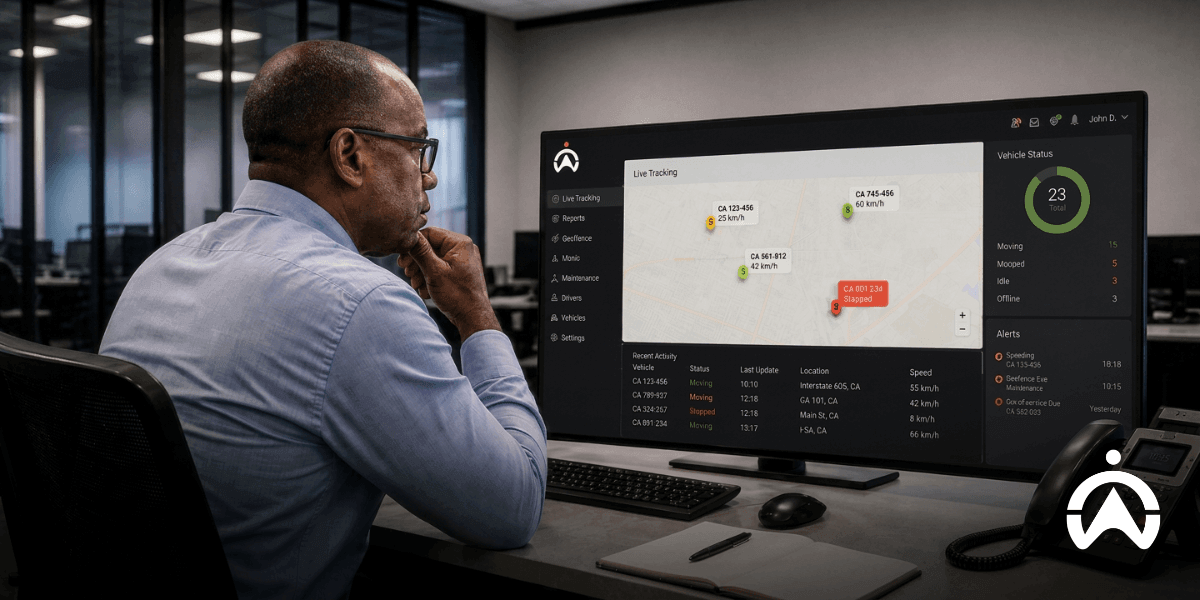
A fleet management system has quite a few key functions. Let’s break them up into sections. First is the hardware in the vehicle, then it’s the network that moves the data, and finally the software turns that data into something that a fleet manager can act upon.
These are actual devices that get installed into the vehicle. This includes:
The data is then captured and transmitted to a platform. The live location data is updated every few seconds to a minute through the network. The device will also store the readings internally, and if the device loses signal, it’ll sync and automatically relay the information back to the platform.
This is the dashboard that fleet managers will actually use. For a public transport operator this is the data and information you’ll typically require:
Fuel is known as the largest cost for any fleet. It’s also the most difficult loss to spot, but did you know that it's also your most controllable? The U.S. Department of Energy found that fuel-efficient driving habits—alone—can improve your fuel economy by 15% to 30% at highway speeds and 10% to 40% in stop-and-go traffic.
Every minute a vehicle isn’t moving but has its engine running, fuel is being wasted. Cartrack’s fleet management system can distinguish between productive idling and unproductive idling so you can spot and stop the waste before it burns into your fuel budget.
Maintenance data is important for a public transport fleet because it can stop your fleet from having unexpected downtime that affects your schedules and the schedules of your passengers. And because you’ll be alerted to a problem before it can break down a vehicle, a R60,000 roadside breakdown is now a R2,000 scheduled repair.
What a fleet management system essentially does is give you complete operational insights on your fleet while shifting you from a reactive to a proactive management style.
Cartrack wants to support public transport fleets by not only assisting with efficiency but also letting operators know exactly what’s happening on their routes and in their vehicles. Visibility is key for any fleet; without it, you won’t truly know how your fleet is operating.
But don’t just take our word for it.
Lintas Shuttle is a transportation service company in Indonesia. Their fleet operates in multiple shifts with strict departure schedules, serving both individual passengers and corporate clients. Hundreds of fleet units operate simultaneously with daily repetitive travel patterns and precise pick-up and drop-off times.
Their main challenges were:
Lintas Shuttle improved real-time visibility, operational control, and service consistency across its intercity and airport routes by using Cartrack’s integrated fleet management system. With features like real-time tracking, route optimisation, driver scorecards, fuel monitoring, and Live Vision, they were able to cut costs, increase fleet efficiency, enhance driver safety, and improve passenger satisfaction.
“We decided to try using Cartrack, and the results met our expectations. After implementing Cartrack, all of our operations became more transparent. With Cartrack’s GPS, we are able to monitor the location of all vehicles. We can also monitor fuel refuelling through the Fuel Sensor, ensuring fuel is used efficiently. In addition, we can monitor driver behaviour in real time through the in-cabin camera.” — Panca Diningrat, Lintas Shuttle Fleet & Vehicle Manager
If you don’t want your public transport fleet to be the last resort for commuters, it’s time to give us a call and spoil your fleet with one of the best global fleet management systems on the market!
Find out how public transport fleet management systems improve safety and efficiency for South Africa’s bus and taxi operators.